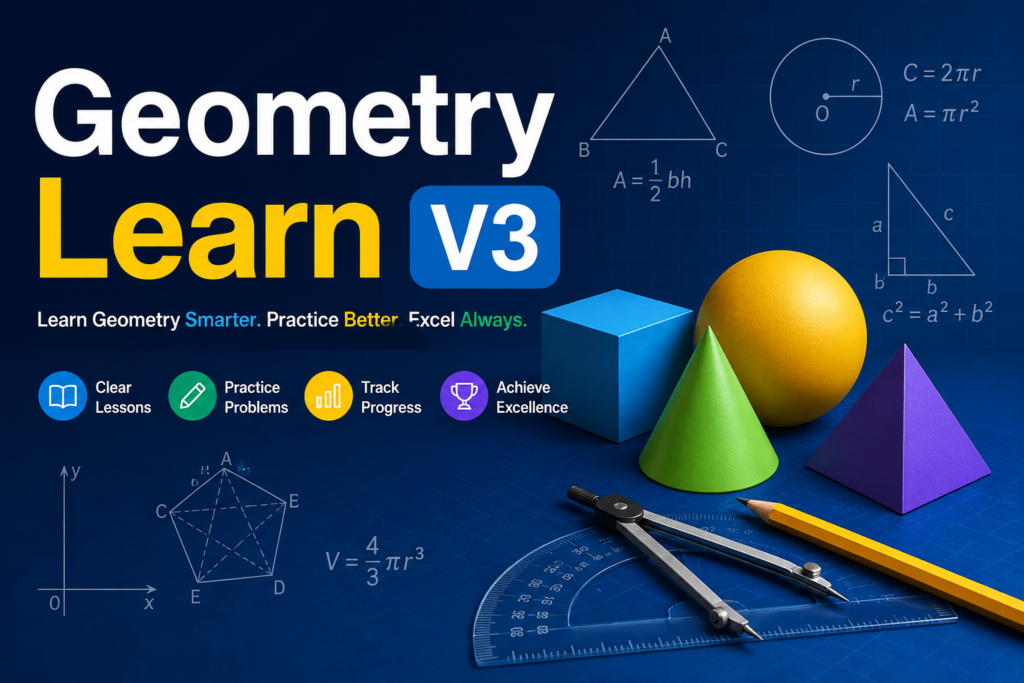

Geometry remains one of the most important branches of mathematics, influencing everything from architecture and engineering to computer graphics and design. As educational technology continues to evolve, digital learning platforms have transformed how students understand shapes, angles, measurements, and spatial reasoning. Among the tools attracting attention from learners and educators is geometry learn v3, a modern approach designed to make geometry more accessible, interactive, and engaging.
For students across the United Kingdom, mastering geometry often requires more than memorising formulas and definitions. Visual learning, hands-on practice, and immediate feedback can significantly improve comprehension and long-term retention. This is where geometry learn v3 stands out, offering a structured environment that helps learners explore geometric concepts through interactive experiences rather than passive study methods.
This guide examines geometry learn v3 in depth, including its features, educational value, learning benefits, practical applications, and how it supports different types of students. Whether you are a secondary school student, parent, teacher, or independent learner, understanding how this platform works can help you make informed decisions about improving mathematical skills and achieving better learning outcomes.
What Is Geometry Learn V3?
Geometry learn v3 is a digital learning platform focused on helping users understand geometric principles through interactive lessons, visual demonstrations, and practical exercises. Unlike traditional textbooks that often rely heavily on static diagrams, modern geometry learning tools encourage active participation and experimentation. Learners can manipulate shapes, explore relationships between angles, and observe mathematical concepts in real time.
One of the defining characteristics of geometry learn v3 is its emphasis on visual understanding. Geometry is naturally a visual subject, and many students struggle when concepts are presented only through equations and written explanations. By incorporating dynamic representations, the platform enables users to see how geometric rules operate, making abstract ideas easier to grasp and apply.
The platform is designed to support various educational levels, from beginners learning basic shapes to advanced students exploring complex geometric relationships. This flexibility allows learners to progress at their own pace while building confidence through gradual skill development. The result is a more engaging educational experience that aligns with modern teaching methods and student expectations.
Why Geometry Matters in Modern Education
Geometry serves as a foundational component of mathematics education because it develops logical reasoning and problem-solving abilities. Students who understand geometric concepts often perform better in related subjects such as algebra, physics, engineering, and computer science. Learning geometry also strengthens spatial awareness, which is valuable in many academic and professional disciplines.
In the United Kingdom, geometry forms an important part of the national mathematics curriculum. Students encounter geometric concepts throughout primary and secondary education, including shape properties, transformations, measurements, and coordinate systems. Success in these areas contributes to stronger examination performance and broader mathematical competence.
Beyond academic requirements, geometry influences everyday life in surprising ways. From interpreting maps and designing living spaces to understanding digital graphics and construction projects, geometric thinking plays a role in countless activities. Platforms such as geometry learn v3 help bridge the gap between classroom learning and practical application by demonstrating how geometry functions in real-world situations.
Key Features of Geometry Learn V3
A major strength of geometry learn v3 is its interactive learning environment. Instead of merely reading explanations, students can engage directly with geometric figures and mathematical models. This hands-on approach promotes active learning and allows users to discover relationships independently while receiving immediate visual feedback.
The platform typically incorporates guided lessons that build knowledge progressively. Students begin with fundamental concepts before advancing to more challenging topics. This structured pathway helps prevent confusion and ensures learners develop a strong foundation before tackling advanced material. Consistent progression supports long-term retention and academic confidence.
Another notable feature involves practice and assessment tools. Geometry learn v3 often includes exercises designed to reinforce concepts through repetition and application. Immediate feedback enables students to identify mistakes quickly, understand correct solutions, and improve their problem-solving strategies. This continuous learning cycle contributes to greater mastery and improved educational outcomes.
Benefits for Students in the United Kingdom
Students in the UK often face increasing academic expectations as they progress through Key Stages and prepare for GCSE examinations. Geometry learn v3 can support this journey by providing supplementary learning opportunities outside the classroom. Interactive resources allow students to review difficult topics independently and strengthen areas requiring additional attention.
The platform also accommodates different learning styles. Some students learn effectively through reading, while others benefit from visual demonstrations or practical exploration. Geometry learn v3 combines multiple instructional methods, helping a broader range of learners understand complex concepts. This versatility can be particularly valuable for students who struggle with conventional teaching approaches.
Another advantage is flexibility. Learners can access geometry learn v3 according to their own schedules and study preferences. This convenience supports revision, homework completion, and exam preparation without requiring attendance at additional classes. By offering accessible and engaging learning experiences, the platform helps students maintain consistent progress throughout the academic year.
How Interactive Learning Improves Understanding
Research consistently shows that active participation enhances learning outcomes. When students interact with mathematical concepts rather than simply observing them, they develop deeper understanding and stronger retention. Geometry learn v3 leverages this principle by encouraging exploration, experimentation, and discovery within a structured educational environment.
Interactive geometry activities allow learners to test hypotheses and observe results immediately. For example, adjusting angles within a shape can reveal how geometric relationships change while preserving fundamental mathematical rules. These experiences help students internalise concepts more effectively than memorising isolated facts or procedures.
Visual feedback further strengthens comprehension by connecting abstract theories to observable outcomes. Many learners find geometry challenging because they cannot easily visualise relationships described in textbooks. Geometry learn v3 addresses this challenge by transforming theoretical concepts into interactive experiences that make mathematical ideas clearer, more memorable, and easier to apply.
Supporting Teachers and Educational Institutions
Teachers continually seek resources that enhance classroom instruction while maintaining curriculum alignment. Geometry learn v3 can serve as a valuable educational supplement by providing interactive content that reinforces lessons taught during school hours. This additional support helps educators present geometric concepts in engaging and accessible ways.
Classroom integration becomes more effective when students can continue learning beyond scheduled lessons. Geometry learn v3 enables teachers to recommend targeted activities that correspond to specific curriculum topics. Students can revisit challenging concepts independently, allowing classroom time to focus on discussion, application, and deeper understanding.
Educational institutions also benefit from technology-enhanced learning tools that promote student engagement. Interactive platforms often generate greater enthusiasm for mathematics by transforming traditionally difficult topics into enjoyable learning experiences. Increased engagement frequently leads to improved participation, stronger academic performance, and greater confidence in mathematical abilities.
Real-World Applications of Geometry Learn V3
Geometry is not limited to classrooms and examinations. Many professions rely heavily on geometric principles, including architecture, engineering, construction, animation, product design, and computer programming. Understanding these applications can increase student motivation by demonstrating the practical value of mathematical knowledge.
Geometry learn v3 helps connect theoretical learning to real-world contexts. Through visual examples and interactive exercises, students can see how geometric concepts influence building structures, transportation systems, digital technologies, and artistic creations. These connections make learning more relevant and meaningful.
Exposure to practical applications may also inspire future career interests. Students who develop strong geometric reasoning skills often discover opportunities in STEM fields and creative industries. By presenting geometry as a useful and dynamic subject rather than a collection of formulas, geometry learn v3 encourages curiosity, exploration, and lifelong learning.
Geometry Learn V3 and Future Learning Trends
Educational technology continues to evolve rapidly, with increasing emphasis on personalised learning experiences. Geometry learn v3 reflects this broader trend by offering flexible pathways that adapt to individual learning needs. Personalisation allows students to focus on specific areas for improvement while progressing at comfortable speeds.
Future developments in digital education may introduce even more sophisticated learning experiences, including advanced visualisation tools, artificial intelligence support, and immersive educational environments. Platforms focused on interactive mathematics are well positioned to benefit from these innovations and provide increasingly effective learning solutions.
As schools and universities continue integrating technology into education, platforms such as geometry learn v3 are likely to play a growing role in mathematics instruction. Their ability to combine accessibility, engagement, and educational effectiveness aligns closely with modern expectations for high-quality learning resources and student-centred education.
Information Table
| Topic | Details |
| Primary Focus | Interactive geometry learning |
| Intended Users | Students, teachers, independent learners |
| Learning Style | Visual and interactive |
| Main Benefit | Improved geometric understanding |
| Educational Use | Classroom support and self-study |
| UK Relevance | Supports geometry topics in the UK curriculum |
Conclusion
Geometry remains an essential component of mathematical education, supporting logical reasoning, spatial awareness, and problem-solving skills that extend far beyond the classroom. For students, educators, and independent learners in the United Kingdom, finding effective ways to master geometric concepts is increasingly important in a technology-driven educational landscape.
Geometry learn v3 offers a modern solution by combining interactive learning, visual demonstrations, structured lessons, and practical exercises into a comprehensive educational experience. Its emphasis on active participation helps learners understand complex concepts more effectively than traditional methods alone, while its flexibility accommodates diverse learning styles and academic needs.
As digital learning continues to shape the future of education, tools like geometry learn v3 demonstrate how technology can enhance understanding, increase engagement, and improve learning outcomes. Whether used for classroom support, independent study, or examination preparation, it represents a valuable resource for anyone seeking a deeper and more confident understanding of geometry.