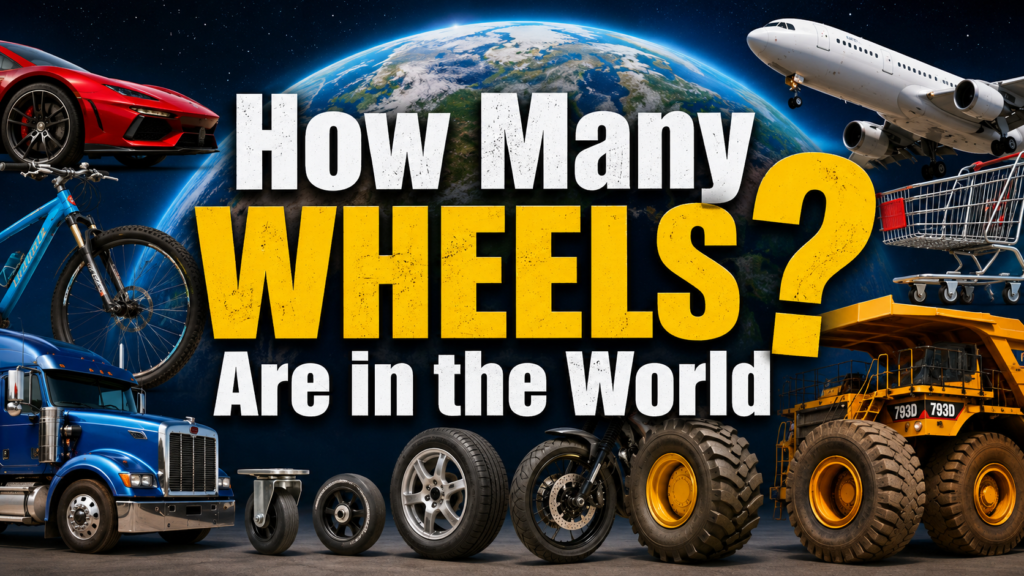

If you’ve ever wondered how many wheels are in the world, you’re not alone. It is one of those surprisingly interesting questions that has sparked countless online debates. At first glance, the answer may seem simple, but once you begin considering every vehicle, suitcase, shopping trolley, toy, machine, and industrial application, the total becomes incredibly difficult to estimate.
The question how many wheels are in the world has no official answer because no global organization tracks every wheel ever manufactured. However, by looking at different industries and everyday products, we can build a realistic estimate that highlights just how common wheels are in modern life.
What Counts as a Wheel?
Before estimating how many wheels exist worldwide, it is important to define what qualifies as a wheel.
A wheel is a circular object designed to rotate around an axle. While most people immediately think of car wheels, the definition extends much further. Bicycle wheels, motorcycle wheels, train wheels, aircraft landing gear, shopping trolley wheels, office chair casters, skateboard wheels, toy vehicle wheels, luggage wheels, industrial rollers, hospital equipment wheels, warehouse carts, and countless factory machines all contribute to the total.
Even many robots and automated systems rely on wheels to move efficiently.
Why It Is Impossible to Know the Exact Number
There is no worldwide database that records every wheel produced or currently in use.
Manufacturers produce billions of wheels every year across hundreds of industries. Some products remain in service for decades, while others are discarded after only a few years. New vehicles, toys, furniture, and industrial equipment are constantly entering the market, making the total change every single day.
Because of these factors, answering how many wheels are in the world requires careful estimation rather than an exact calculation.
Passenger Cars Contribute Billions of Wheels
Cars are one of the largest contributors to the world’s wheel count.
There are well over one billion passenger vehicles operating across the globe. Since most cars have four primary wheels and many also carry a spare, passenger vehicles alone account for several billion wheels.
Commercial vehicles such as taxis, vans, and company fleets increase this number even further.
Trucks and Heavy Transport Add Millions More
Heavy trucks may have anywhere from six to eighteen or more wheels depending on their design.
Long-distance freight vehicles, construction trucks, mining equipment, military vehicles, and buses collectively contribute hundreds of millions of additional wheels worldwide.
Because these vehicles often use multiple axles, they contain significantly more wheels than ordinary passenger cars.
Bicycles Are Everywhere
Bicycles remain one of the world’s most popular forms of transportation.
With estimates exceeding one billion bicycles globally, their two wheels each create another enormous contribution to the overall total.
Many households own several bicycles, while rental services, sports clubs, and delivery companies continue expanding bicycle usage across cities.
Motorcycles and Scooters Increase the Count
Motorcycles, scooters, and mopeds are especially common throughout Asia, Europe, and many developing countries.
Most have two wheels, although three-wheeled scooters and specialty motorcycles also exist. Together they add hundreds of millions more wheels to the global estimate.
Trains and Rail Systems Depend on Large Numbers of Wheels
Every railway carriage contains numerous steel wheels.
Passenger trains, freight trains, subway systems, trams, and maintenance vehicles all require large numbers of wheels to operate safely. Although there are fewer trains than cars, each train consists of multiple connected vehicles, resulting in thousands of wheels per train set.
Aircraft Also Use Wheels
Airplanes spend most of their time flying, yet every aircraft depends on wheels during take-off, landing, and ground operations.
Large commercial aircraft may have dozens of landing gear wheels, while smaller private aircraft generally have three. Airports also use countless baggage carts, maintenance vehicles, and transport equipment equipped with wheels.
Industrial Equipment Contains Massive Numbers of Wheels
Factories represent one of the most overlooked sources when estimating how many wheels are in the world.
Production lines use rollers, conveyor systems, transport carts, robotic platforms, warehouse equipment, pallet movers, and automated guided vehicles. Manufacturing plants around the world operate millions of these components every day.
Industrial applications likely account for billions of additional wheels.
Office Furniture Adds Surprisingly Large Numbers
Modern offices contain rolling chairs almost everywhere.
Most office chairs have five caster wheels. Considering the hundreds of millions of offices, schools, universities, libraries, and home workspaces worldwide, office furniture alone contributes billions of wheels.
Mobile filing cabinets and office trolleys further increase this number.
Luggage Has Increased Wheel Production
Travel has transformed suitcase design.
Older luggage often required carrying, but modern suitcases usually include two or four wheels. With hundreds of millions of suitcases owned around the world, luggage has become another major contributor to the global wheel count.
Airports also use thousands of wheeled carts every day.
Shopping Trolleys and Warehouse Carts
Retail businesses depend heavily on wheels.
Every supermarket shopping trolley uses four wheels. Distribution centres, warehouses, airports, hospitals, and logistics companies also rely on wheeled carts for transporting goods efficiently.
The rapid growth of online shopping has increased demand for warehouse equipment containing wheels.
Children’s Toys May Outnumber Vehicle Wheels
One of the biggest surprises when discussing how many wheels are in the world is the contribution from children’s toys.
Toy cars, toy trains, ride-on toys, doll prams, scooters, roller skates, skateboards, remote-controlled vehicles, and building sets containing wheels exist in enormous quantities.
Many children own dozens of toy vehicles, meaning toy wheels may actually exceed the number of wheels found on real vehicles.
This possibility became widely discussed after online debates compared the number of wheels to the number of doors around the world.
Medical Equipment Relies on Wheels
Hospitals use wheels extensively.
Wheelchairs, patient beds, medicine trolleys, emergency stretchers, surgical equipment, monitoring stations, and portable diagnostic machines all depend on wheels for mobility.
Healthcare facilities worldwide contain millions of wheeled devices operating around the clock.
Agriculture Depends on Large Wheels
Modern farming equipment uses large and durable wheels.
Tractors, harvesters, trailers, irrigation equipment, sprayers, and utility vehicles all contribute millions of wheels globally.
Many farms also use wheelbarrows, carts, and machinery designed for transporting crops efficiently.
Construction Sites Are Full of Wheels
Construction projects rely on equipment with wheels every day.
Concrete mixers, dump trucks, cranes, forklifts, excavators with wheeled designs, trailers, generators, compressors, and mobile work platforms all require wheels for transportation and operation.
The construction industry therefore represents another significant contributor.
Everyday Household Items Include More Wheels Than You Might Expect
Many people underestimate the number of wheels inside their own homes.
Office chairs, toy boxes, vacuum cleaners, storage drawers, baby strollers, prams, shopping trolleys, rolling shelves, furniture casters, lawn equipment, wheelbarrows, and luggage all add to the total.
A typical household may easily contain dozens of wheels before even considering bicycles or cars.
A Realistic Global Estimate
Although no precise figure exists, many analysts believe the world contains well over one hundred billion wheels.
Some estimates suggest the total could approach several hundred billion when accounting for toys, industrial machinery, furniture, logistics equipment, manufacturing systems, healthcare devices, transportation, agriculture, and household products.
Since billions of new wheels are manufactured every year, the number continues growing rapidly.
Therefore, when someone asks how many wheels are in the world, the most reasonable answer is that there are likely hundreds of billions of wheels currently in existence.
Conclusion
The question how many wheels are in the world is far more complex than it initially appears. Cars, trucks, bicycles, trains, aircraft, factories, offices, hospitals, farms, toys, luggage, shopping trolleys, and countless everyday products all contribute to an astonishing global total. While nobody can provide an exact count, careful estimates suggest the number almost certainly reaches into the hundreds of billions. As technology advances and manufacturing continues expanding, that figure will only continue to rise, making wheels one of the most common mechanical components ever created.