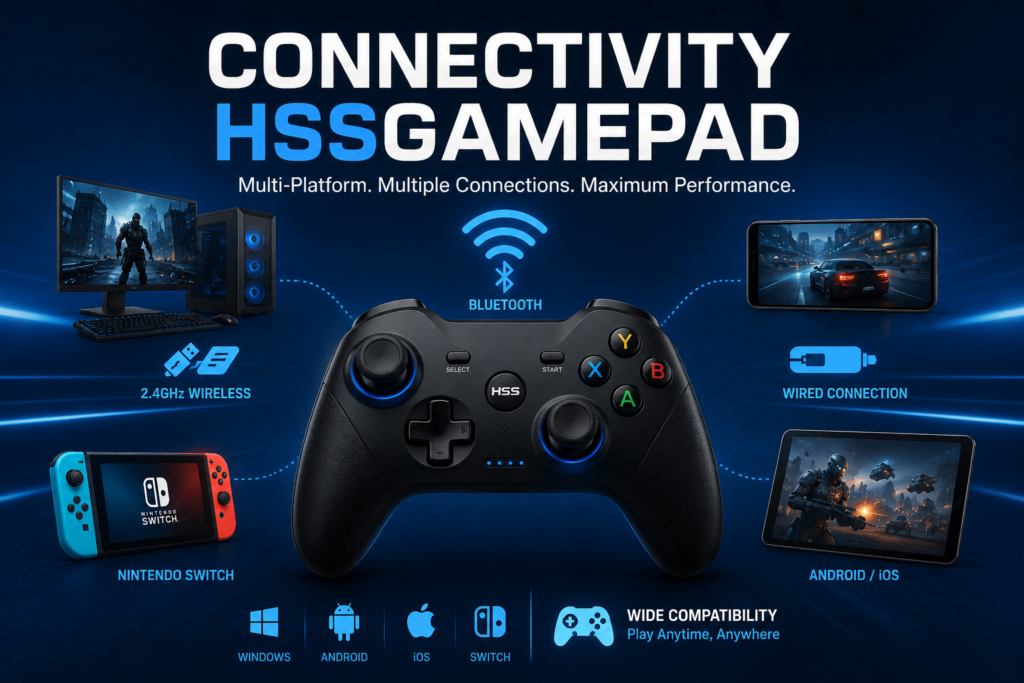

If you’ve just unboxed a new controller or you’re battling a connection that keeps dropping mid-match, understanding connectivity hssgamepad setup is the first thing you need to sort out. This controller has quietly become one of the more popular budget gaming accessories in the UK, largely because it offers three different ways to connect rather than forcing you into one method. But with flexibility comes confusion, and plenty of users get stuck somewhere between pairing mode and actual gameplay. This guide walks through exactly how each connection type works, how to set them up properly on every major platform, and how to fix the problems that crop up most often. By the end, you’ll know precisely which mode suits your setup and how to keep it running smoothly.
What Is Connectivity HSSGamepad and Why It Matters
Connectivity hssgamepad refers to the way this particular controller communicates with your phone, tablet, laptop, or television. Unlike many entry-level controllers that only offer a single wired connection, the HSS Gamepad supports Bluetooth pairing, a 2.4GHz wireless dongle, and traditional USB. That range of options is precisely why it appeals to such a broad audience, from casual mobile gamers to people running emulators on an ageing PC. Each method has its own strengths, and knowing which one fits your situation prevents a lot of unnecessary frustration later on.
The reason connectivity matters so much with any gamepad is timing. Every button press, joystick tilt, and trigger pull has to travel from the controller to your device and register in the game almost instantly. When that signal path is interrupted by interference, a weak battery, or a poor pairing, you feel it immediately as lag, missed inputs, or a controller that simply won’t respond. A stable connection isn’t a nice extra; it’s the difference between a controller that feels responsive and one that makes you want to throw it across the room.
What sets a well-configured setup apart is understanding that not all connection types are equal for every purpose. Wireless freedom is brilliant for casual living-room sessions, but competitive players chasing split-second reactions often need something more consistent. This is where knowing the mechanics behind each mode becomes genuinely useful rather than just technical trivia. The sections below break down exactly how to choose and configure the right one for your needs.
The Three Connection Modes Explained: Bluetooth, 2.4GHz, and USB
Bluetooth is the most widely used connection method because it requires no extra hardware and works natively with almost every modern smartphone, tablet, and laptop. It’s ideal if you want to switch between devices frequently or you simply don’t want cables trailing across the sofa. The trade-off is that Bluetooth shares the same 2.4GHz frequency band as Wi-Fi routers, microwaves, and other wireless accessories, which can occasionally introduce small stutters, particularly in busy households with multiple connected devices running at once.
The 2.4GHz wireless dongle is the option most competitor guides gloss over, yet it’s arguably the best middle ground between convenience and performance. Rather than relying on your device’s built-in Bluetooth radio, the gamepad communicates with a small USB receiver over a dedicated channel, which tends to reduce interference and shave a few milliseconds off input latency. This makes it a strong choice for PC gaming, streaming boxes, and smart TVs where a dongle can sit permanently plugged in without getting in the way.
USB wired mode remains the gold standard for reliability. Because data travels through a physical cable rather than over the air, there’s essentially zero risk of dropped signals or interference, and most systems recognise the controller instantly without needing additional drivers. It does sacrifice the freedom of movement that wireless offers, but for fighting games, emulation setups, or any scenario where split-second timing genuinely matters, plugging in remains the safest bet. Many players actually keep all three options available and switch depending on what they’re playing.
Step-by-Step Bluetooth Pairing Guide
Getting Bluetooth working correctly starts with putting the controller into pairing mode, which usually involves holding down a dedicated button until the indicator light begins flashing rapidly rather than staying solid. This flashing pattern tells you the gamepad is actively broadcasting and ready to be discovered, so don’t skip this step even if you’ve paired the controller before. On most models this takes no more than three to five seconds of holding the button, though it’s worth checking your specific manual since button placement varies slightly between HSS Gamepad versions.
Once pairing mode is active, open the Bluetooth settings on whichever device you’re connecting to and scan for nearby devices. The controller should appear as “HSS Gamepad” or something closely resembling it within a matter of seconds. Tap or click to connect, and the flashing light should switch to a solid glow once the pairing handshake completes successfully. If you’re on a Windows machine, you may occasionally be prompted for a PIN; simply pressing Enter on a blank field or entering four zeros typically resolves this without further hassle.
After pairing, it’s worth testing every input before jumping straight into a game, since a connection can technically succeed while individual buttons or analogue sticks fail to register correctly. Free controller-testing apps are available on both Android and iOS app stores and provide a quick visual confirmation that everything works as expected. If the controller shows as connected but nothing responds in-game, check the game’s own settings menu, as some titles require external controller support to be manually enabled before inputs are recognised.
Platform Compatibility Across Android, iOS, Windows, and Smart TVs
Android devices offer the broadest and most reliable compatibility with the HSS Gamepad. Most modern Android phones and tablets running Android 8.0 or later detect the controller automatically once paired, and popular mobile titles, along with emulator apps, tend to recognise the inputs without additional configuration. If your device lacks Bluetooth entirely or you prefer a wired connection, an OTG adapter allows you to plug the controller directly into a USB-C port for instant recognition.
Windows PCs generally provide the smoothest experience of any platform, since the operating system installs the necessary drivers automatically for most connection modes. The controller is typically recognised as either an XInput or DirectInput device, with XInput being the standard most contemporary games and platforms like Steam expect by default. iOS and iPadOS support is more limited by comparison, since Apple requires controllers to meet specific framework standards, and not every game on the App Store supports external controllers even when the hardware connection itself works perfectly.
Smart TVs and Android TV boxes generally connect well through either the 2.4GHz dongle or Bluetooth, making the HSS Gamepad a solid option for cloud gaming services or retro emulation on the big screen. It’s worth noting, however, that the controller isn’t designed to replace dedicated console controllers on systems like Xbox or PlayStation, since those platforms use proprietary wireless protocols that third-party gamepads typically can’t access without specific licensing. Checking compatibility before purchase, particularly for console use, saves considerable disappointment later.
Fixing Common HSS Gamepad Connectivity Problems
The single most frequent cause of connection failures is a controller that simply hasn’t been put into pairing mode correctly, or one that’s already connected to a different device and therefore invisible to new pairing attempts. Since the HSS Gamepad can typically only maintain an active connection with one device at a time, disconnecting it from your phone before attempting to pair it with a PC, or vice versa, resolves a surprising number of “device not found” complaints almost instantly.
Another common culprit is what’s sometimes called a ghost connection, where your device holds onto old, corrupted pairing data from a previous session. When this happens, the two devices attempt to reconnect using mismatched information and fail silently, often without any clear error message. The fix is straightforward: locate the HSS Gamepad entry in your Bluetooth settings, select “forget” or “unpair,” and then start the pairing process again from scratch. This clears the stored connection profile and usually resolves persistent dropouts immediately.
Battery health also plays a bigger role than most people expect. As the charge drops below roughly twenty percent, wireless signal strength weakens noticeably, which can cause intermittent disconnects even when everything else is configured correctly. If your controller is more than a year or so old and continues to misbehave after a full charge, the battery itself may be degrading and could eventually need replacing. For anyone still experiencing issues after trying these fixes, switching temporarily to USB wired mode almost always confirms whether the problem lies with the wireless connection or the controller itself.
Tips for a Stable, Long-Term Connection
Keeping your controller within a reasonable range of your device makes a bigger difference than most players realise, since wireless signals naturally weaken over distance and through physical obstructions like walls or furniture. For Bluetooth specifically, staying within a few metres during the initial pairing process, then allowing more distance once the connection is established, tends to produce the most reliable results over an extended gaming session.
Reducing wireless interference is equally important, particularly in homes with several connected devices competing for the same frequency band. Keeping the 2.4GHz dongle away from Wi-Fi routers, other Bluetooth accessories, and even microwaves can noticeably cut down on the micro-stutters that plague busy households. Regularly updating your device’s drivers and the controller’s firmware, when updates are available, also closes small compatibility gaps that manufacturers address over time.
Finally, treating the battery with a bit of care pays off in the long run. Charging the controller fully before longer sessions, rather than letting it run flat repeatedly, helps preserve battery health and reduces the chance of a mid-game disconnection. For anyone serious about competitive play, switching to the 2.4GHz dongle or a wired USB connection removes most of the variables that cause instability altogether, leaving Bluetooth as the convenient option for everyday, casual use.
Final Thoughts
Getting connectivity hssgamepad setup right ultimately comes down to matching the connection method to how you actually play. Bluetooth suits convenience and mobile gaming, the 2.4GHz dongle strikes a strong balance for PC and TV setups, and wired USB remains unbeatable when stability matters most. Most of the problems people run into, from failed pairings to random disconnects, trace back to a handful of familiar causes: pairing mode not activated properly, leftover connection data, low battery, or interference from nearby wireless devices. Once you understand those patterns, troubleshooting becomes far less intimidating.
There’s no single “correct” way to connect this controller, only the option that best fits your gaming habits at any given moment. Casual players will likely find Bluetooth perfectly adequate, while anyone chasing precision in fast-paced or competitive titles should lean toward the dongle or a cable. With the setup steps and fixes covered here, you should be well equipped to get your HSS Gamepad connected reliably, whatever device you’re gaming on.